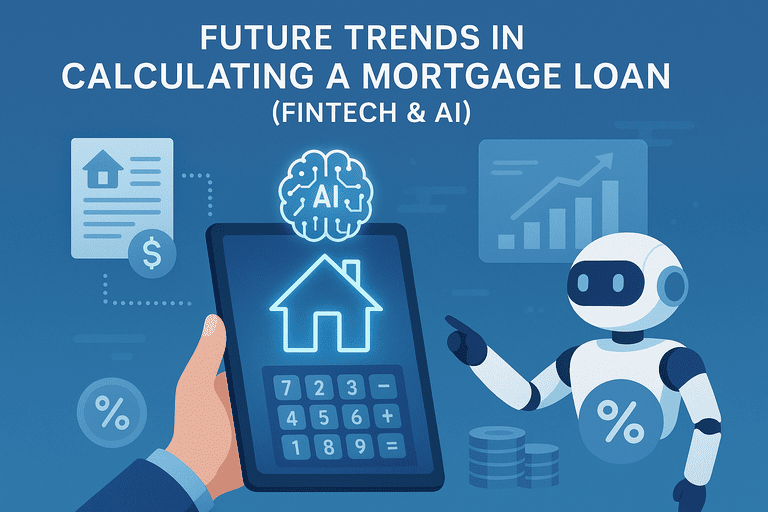
Mortgage loan calculations have come a long way—from pen-and-paper math to online calculators, and now into the era of artificial intelligence and fintech innovation. By 2025 and beyond, calculating a mortgage won’t just be about plugging numbers into a formula; it will be about personalized insights, predictive analysis, and real-time financial optimization. For today’s fundamentals, see our Complete Guide
This guide explores the biggest trends shaping how we’ll calculate mortgages in the near future.
1. Smarter, AI-Driven Mortgage Calculators
Traditional calculators provide basic outputs (monthly payments, amortization). AI-powered tools are different:
Personalized Results – AI considers your income, spending habits, and goals.
Scenario Testing – Instantly compares 15-year vs. 30-year, extra payments, or refinancing options.
Predictive Analysis – Forecasts how inflation or rate changes could affect your loan.
Real-Time Rate Shopping – Connects directly to lender databases for up-to-the-minute offers.
2. Fintech Integration with Banking & Credit Data
Fintech platforms are making mortgage planning seamless by pulling in:
Bank Account Data – For accurate budgeting and affordability analysis.
Credit Reports – For personalized rate predictions.
Tax Records – For self-employed borrower calculations.
APIs with Lenders – Allowing instant pre-qualification and side-by-side comparisons.
This means borrowers will soon calculate and apply for a mortgage in a single, integrated experience.
3. Mobile-First Mortgage Tools
As younger generations enter the housing market, mobile mortgage apps are becoming standard. Expect:
One-tap calculators.
Push notifications for refinance opportunities.
In-app affordability dashboards.
Augmented reality integrations (e.g., scanning a listing to see estimated payments instantly).
4. Blockchain and Smart Contracts
Blockchain technology could revolutionize not just mortgage lending but also how we calculate costs. Future tools may:
Use smart contracts to auto-update calculations as payments are made.
Provide transparent loan histories for buyers and lenders.
Reduce errors and fraud by ensuring data integrity.
5. Predictive Mortgage Planning
With AI and big data, borrowers will be able to:
See how different career or income scenarios impact affordability.
Model how future rate changes affect refinancing opportunities.
Get alerts for the best time to lock in rates.
Instead of reactive calculations, mortgage planning will become proactive and dynamic.
6. Human + AI Collaboration
Even with advanced tools, human expertise will still matter. Expect hybrid systems where:
AI runs the numbers instantly.
Mortgage advisors interpret results and guide long-term strategy.
Borrowers benefit from both speed and human judgment.
Conclusion
The future of mortgage loan calculation lies in fintech innovation, AI personalization, and predictive insights. Instead of static numbers, borrowers will interact with dynamic tools that factor in real-time rates, personal financial data, and long-term scenarios.
By embracing these technologies early, homebuyers and investors can gain a major advantage in understanding—and optimizing—their mortgage decisions.