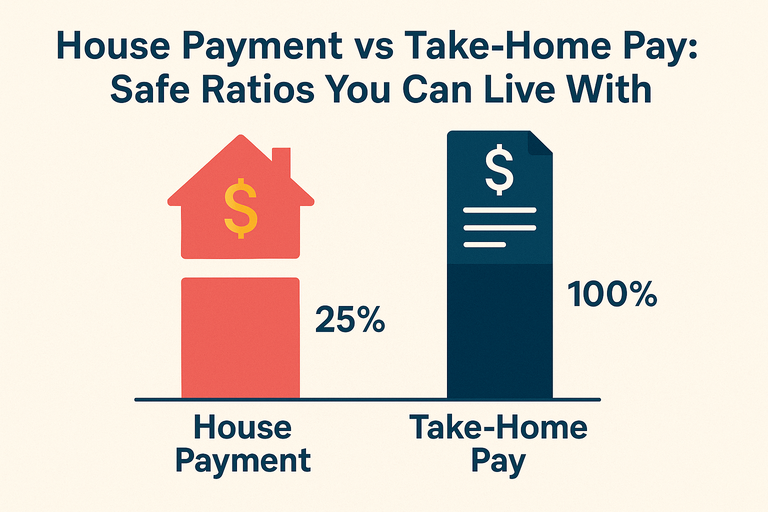
Your mortgage payment shouldn’t keep you awake at night.
The key to comfortable homeownership is knowing how much of your income can safely go toward housing — and where to draw the line before lifestyle or savings take a hit.
In this guide, we’ll walk through:
The 28/36 rule used by lenders,
How to factor net vs gross income,
And how to use the House Payment Calculator to find your safe range.
1. The 28/36 Rule: The Gold Standard of Affordability
Mortgage lenders use two critical ratios to measure affordability:
| Ratio | What It Measures | Ideal Threshold |
|---|---|---|
| Front-End (Housing) | % of income spent on mortgage (PITI) | ≤ 28% |
| Back-End (Total Debt) | % of income spent on all debt | ≤ 36% |
PITI = Principal + Interest + Taxes + Insurance (and sometimes HOA fees)
Example:
If you earn $6,000 gross monthly income:
28% housing limit = $1,680
36% total debt limit = $2,160 (including car loans, credit cards, etc.)
If your projected payment exceeds these, your budget may feel tight — and your loan options shrink.
Try both limits instantly in the Debt-to-Income Calculator to see your lender-approved range.
2. Gross vs Net Income: What You Actually Live On
Lenders calculate ratios using gross income (before taxes), but your take-home pay (after taxes and deductions) is what really matters for budgeting.
| Monthly Income Type | Example | Safe House Payment (≈ 25–30%) |
|---|---|---|
| Gross | $6,000 | $1,500–$1,800 |
| Net (After Taxes) | $4,500 | $1,100–$1,350 |
The difference is huge: A “safe” loan on paper might still feel stressful in real life.
Rule of thumb:
Use your net income to set your personal comfort limit — not just what a lender allows.
3. Using the House Payment Calculator Correctly
Go to the House Payment Calculator and input:
Loan amount (home price – down payment)
Interest rate (get it from your preapproval or our Mortgage Payment Calculator)
- Loan term (15 or 30 years)
Property taxes and insurance
Then look at:
Total monthly payment (PITI)
Compare that number to 28% of gross income or 25% of take-home pay
That’s your affordability “sweet spot.”
4. Budgeting by Percentages: The 50/30/20 Rule Meets 28/36
A healthy post-mortgage budget typically follows this structure:
| Category | % of Take-Home Pay | Example on $4,500/mo |
|---|---|---|
| Needs (including housing) | 50% | $2,250 |
| Wants | 30% | $1,350 |
| Savings & Debt Payoff | 20% | $900 |
Since housing dominates the “needs” category, try to keep your house payment ≤ 25–30% of take-home pay to leave breathing room for everything else.
💡 Use this template alongside the Debt-to-Income Calculator to balance housing with car, student, or personal loans.
5. Example: Finding Your Comfort Zone
Case 1: 30-Year Fixed
Income: $5,000/month gross
Loan: $350,000 @ 6.5%
Taxes + Insurance: $400
→ Payment = $2,610 (52% of net pay) ❌ Too high
Case 2: 30-Year Fixed + Larger Down Payment
Loan: $300,000 @ 6.5%
→ Payment = $2,130 (42% of net pay) ⚠️ Manageable
Case 3: 15-Year Loan
Loan: $300,000 @ 6.0%
→ Payment = $2,533 (56% of net pay) 🚫 Tight despite lower rate
Result:
The 30-year, $300K loan keeps total debt near 36% — the most balanced outcome.
6. How DTI (Debt-to-Income) Shapes Loan Approval
Your DTI ratio determines how much home you can buy.
Lenders often use these limits:
| Loan Type | Max DTI Allowed |
|---|---|
| Conventional | 43% |
| FHA | 50% |
| VA | 41–50% |
| USDA | 41% |
Use our Debt-to-Income Calculator to test different payment scenarios.
7. Net Pay Reality Check: Taxes, Benefits & Deductions
Before locking in a home purchase, subtract:
Federal & state taxes
Retirement contributions (401k, IRA)
Health insurance premiums
Childcare or transportation costs
Only what’s left is spendable income.
Your mortgage should fit comfortably inside that, not dominate it.
8. Budget Template: The “House Payment Stress Test”
Run your household budget like a lender — but smarter.
| Expense | Monthly Limit (on $4,500 net) |
|---|---|
| Housing (PITI + HOA) | ≤ $1,350 |
| Transportation | ≤ $700 |
| Groceries & Utilities | ≤ $800 |
| Debt Payments | ≤ $500 |
| Savings & Investments | ≥ $900 |
| Total | = $4,250 (leaves buffer) ✅ |
9. Adjusting for Local Cost of Living
In high-cost metros (Miami, LA, NYC), stretching slightly beyond 30% might be reasonable — especially with stable income and little debt.
In lower-cost areas, staying closer to 25% offers better savings potential.
Always test multiple scenarios in the House Payment Calculator to see how taxes and insurance differ by ZIP code.
10. Key Takeaways
Lenders approve up to 28/36, but aim for 25–30% of take-home pay for comfort.
Base affordability on net income — what you actually live on.
Use calculators to balance mortgage, DTI, and full budget.
Revisit ratios annually as income, debts, and insurance costs change.
FAQ
What percentage of take-home pay should go toward a house payment?
Ideally 25–30% of your take-home pay or no more than 28% of your gross income.What is the 28/36 rule in mortgages?
Spend ≤28% of your income on housing and ≤36% on all debt combined.Is DTI based on gross or net income?
Lenders use gross income, but you should use net income for personal budgeting.Can I exceed 30% if I have no other debts?
Yes, if your DTI stays below 36% and you still maintain healthy savings.