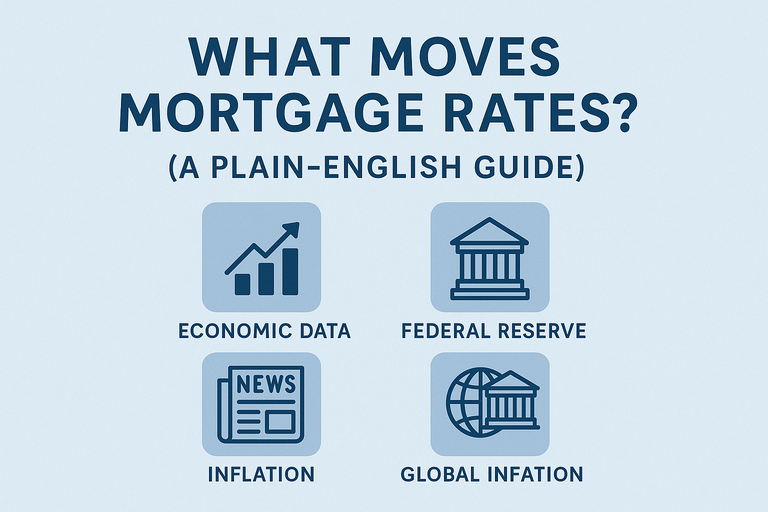
Mortgage rates don’t rise or fall randomly — they follow a set of predictable patterns shaped by inflation, economic data, and investor demand for mortgage-backed securities (MBS).
Understanding these drivers helps you decide when to lock your rate and how to interpret market news that lenders react to.
Here’s the plain-English breakdown of what actually moves mortgage rates — and how to read the clues like a pro.
1. Mortgage Rates Follow the Bond Market — Not the Fed Directly
Contrary to popular belief, mortgage rates don’t move in perfect sync with the Federal Reserve’s benchmark rate.
Instead, they’re tied to the yield on 10-year Treasury notes — the market’s best guess of where long-term borrowing costs are headed.
When Treasury yields rise, mortgage rates usually go up.
When yields fall, mortgage rates drop soon after.
The 10-year Treasury acts as a baseline because most mortgages last around that long before being refinanced or sold.
💡 Use the Mortgage Rate Calculator to test how even a 0.25% rate shift changes your monthly payment.
2. Inflation: The #1 Long-Term Driver
Inflation erodes the value of money over time — and lenders demand higher rates to compensate.
When inflation spikes, rates climb; when inflation cools, rates ease.
| Year | Inflation (CPI) | Avg. 30-Year Fixed Rate | Trend |
|---|---|---|---|
| 2019 | 1.8% | 3.9% | Stable |
| 2021 | 7.0% | 3.1% | Lagged reaction |
| 2022 | 8.0% | 6.6% | Surged |
| 2023 | 3.3% | 6.8% | Plateau |
| 2025* | ~2.4% | ~6.0% | Easing |
*Projection as of early 2025
When inflation expectations fall, bond yields — and mortgage rates — typically follow.
For deeper context, see How Are Mortgage Rates Determined: The Complete Guide
3. Jobs Reports: The Market’s Monthly Shockwave
The U.S. employment report, released the first Friday of every month, can move rates within hours.
Why? Because job growth affects inflation risk and consumer demand.
Strong jobs report: signals more spending → inflation risk → rates rise
Weak jobs report: signals slowdown → lower inflation → rates fall
If you’re shopping for a mortgage, watch the Nonfarm Payrolls (NFP) number — big surprises can cause lenders to reprice rates mid-day.
3. Jobs Reports: The Market’s Monthly Shockwave
The U.S. employment report, released the first Friday of every month, can move rates within hours.
Why? Because job growth affects inflation risk and consumer demand.
Strong jobs report: signals more spending → inflation risk → rates rise
Weak jobs report: signals slowdown → lower inflation → rates fall
If you’re shopping for a mortgage, watch the Nonfarm Payrolls (NFP) number — big surprises can cause lenders to reprice rates mid-day.
5. Mortgage-Backed Securities (MBS): The Real Engine
Behind the scenes, most mortgages are bundled into MBS and sold to investors.
When investors demand these bonds, lenders can offer lower rates.
When demand dries up, rates rise.
MBS yields usually move in lockstep with Treasuries, but they carry an added spread (extra yield) for prepayment and credit risk.
| Factor | Impact on Rates |
|---|---|
| High investor demand for MBS | ↓ Rates |
| Rising prepayment risk | ↑ Rates |
| Fed MBS purchases (QE) | ↓ Rates |
| Private investor selloff | ↑ Rates |
6. Rate Sheet Reality: How Lenders Price Daily
Lenders don’t wait for Fed meetings to change your rate — they update rate sheets daily, sometimes multiple times per day.
Typical rate sheet components:
Base rate: determined by MBS yields that morning
Adjustments: credit score, LTV, loan size, and occupancy
Par rate: the “no points” rate for your profile
Lock pricing: based on expected delivery to investors
📄 Example:
If MBS yields rise 0.25% during the day, lenders might reissue rate sheets with +0.125% higher rates by afternoon.
7. Short-Term Rate Movers: The Weekly Watchlist
Mortgage pros monitor a few recurring data points that can swing rates by the day:
| Economic Report | Why It Matters | Frequency |
|---|---|---|
| CPI (Consumer Price Index) | Inflation gauge | Monthly |
| Jobs Report (NFP) | Employment & wages | Monthly |
| PCE (Personal Consumption Expenditures) | Fed’s preferred inflation metric | Monthly |
| Fed Meeting / Minutes | Policy tone | 6–8 times per year |
| Retail Sales | Consumer spending health | Monthly |
| 10-Year Treasury Auctions | Investor demand snapshot | Monthly |
8. Global and Geopolitical Shocks
Mortgage rates also react to global events:
Oil price spikes → inflation fears → higher rates
Geopolitical instability → “flight to safety” → lower Treasury yields and mortgage rates
Central bank moves abroad → currency shifts → ripple into U.S. bonds
During uncertainty, investors flock to Treasuries, driving yields — and mortgage rates — lower.
9. How Borrowers Can Use This Knowledge
Timing rate locks isn’t about guessing the Fed — it’s about watching trends.
Tips for smarter rate timing:
Track the 10-year Treasury yield daily (below ~4.0% often signals rate relief).
Follow inflation and jobs data — those are the biggest monthly movers.
Lock rates early during volatile markets if you’re near closing.
Float cautiously if inflation trends are easing and reports are favorable.
🧮 Try small rate adjustments in the Mortgage Rate Calculator
10. Key Takeaways
Inflation drives rates long-term; jobs data drives short-term volatility.
Mortgage rates track 10-year Treasury yields, not the Fed directly.
MBS spreads and investor sentiment shape lender pricing day-to-day.
Reading rate sheets helps you spot real-time market direction.
Use calculators to test affordability across rate scenarios.
FAQ
Do mortgage rates follow the Fed?
Not directly — they follow bond market yields, especially the 10-year Treasury.What’s the biggest factor affecting rates today?
Inflation — when it falls, mortgage rates usually follow.Why do rates change daily?
Because MBS prices fluctuate constantly with economic data and investor demand.How can I predict if rates will drop?
Watch inflation reports (CPI, PCE) and 10-year Treasury yield trends — these are the clearest signals.