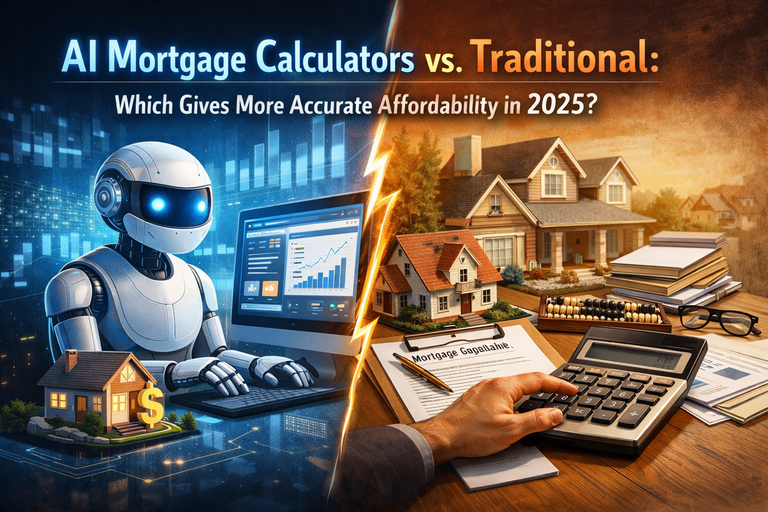
AI mortgage tools are everywhere in 2025. Buyers ask ChatGPT-style tools what they can afford, when to buy, and whether to refinance—often
before touching a traditional mortgage calculator. But here’s the uncomfortable truth:
AI tools are great at explanations. They are weak at underwriting math. This article compares
AI-based mortgage calculators vs traditional calculators using real scenarios, current market conditions, and lender-style logic—so you know when AI helps and when it misleads.
1) What people mean by “AI mortgage calculators”
Most “AI mortgage calculators” are not calculators at all. They are:
- Conversational tools (chatbots)
- Rule-of-thumb estimators
- Scenario explainers
They typically:
- Estimate affordability using averages
- Explain concepts in plain English
- Skip lender-specific constraints
Traditional calculators, by contrast:
- Require structured inputs
- Apply explicit formulas
- Mimic underwriting rules more closely
Actionable tip: If a tool doesn’t ask for
taxes, insurance, DTI, and loan type, it’s not calculating affordability—it’s guessing.
2) How traditional mortgage calculators actually work
A proper mortgage calculator uses:
- Loan amount
- Interest rate
- Loan term
- Property taxes
- Insurance
- PMI (if applicable)
Affordability calculators go further:
- Gross monthly income
- Monthly debts
- DTI caps (often 43–50%)
- Cash requirements
These calculators don’t “think”—but they
don’t hallucinate either.
Actionable tip: Traditional calculators are boring because they’re constrained. That’s why lenders trust them.
3) Side-by-side test: AI vs traditional math
Scenario
- Income: $95,000/year ($7,917/month)
- Debts: $850/month
- Down payment: 10%
- Rate: ~6.3% (2025 context)
- Taxes + insurance: $600/month
AI-style response (typical)
“You can afford around a $450,000–$500,000 home depending on lifestyle.”
Traditional affordability math
Max safe housing at 43% DTI:
- Max total debt: ~$3,400
- Available for housing: ~$2,550
That supports:
- Loan ≈ $360,000–$380,000
- Home price ≈ $400,000–$420,000
That’s a
$60k–$100k difference.
Actionable tip: AI tools tend to
inflate affordability because they don’t enforce DTI ceilings or stress tests.
4) Where AI tools actually shine
AI tools are genuinely useful for:
- Explaining loan types (FHA vs conventional)
- Walking through scenarios (job loss, rate changes)
- Teaching concepts (DTI, PMI, amortization)
- Comparing “what if” situations
They are especially good
before you know what numbers matter.
Actionable tip: Use AI to understand the rules—then use calculators to apply them.
5) Where AI tools fail (this is critical)
AI mortgage tools often:
- Ignore property taxes and insurance variability
- Miss PMI entirely
- Assume refinancing will be available
- Use outdated rate assumptions
- Don’t model payment shock or escrow increases
Worst of all:
They rarely say
“you don’t qualify.” Lenders do.
Actionable tip: If a tool never tells you “this doesn’t work,” it’s not a decision tool.
6) Can AI predict affordability better in the future?
Maybe—but not yet. Accurate affordability requires:
- Real-time lender rules
- County-specific taxes
- Insurance pricing
- Credit-tier pricing
- Program overlays
Until AI tools integrate
live underwriting rules, they will remain advisors—not arbiters.
Actionable tip: Trust math tied to inputs, not confidence tied to language.
7) The best workflow for buyers in 2025
Use a
hybrid approach:
- AI tool → learn concepts and scenarios
- Traditional calculator → test affordability
- Lender preapproval → validate reality
Skipping step 2 is where people get burned.
Actionable tip: If your AI estimate and calculator result differ,
believe the calculator.
Conclusion
AI mortgage tools are powerful explainers—but weak judges. Traditional mortgage calculators remain more accurate for affordability because they enforce constraints lenders actually use. In 2025:
- Use AI to understand
- Use calculators to decide
- Use lenders to confirm
If you reverse that order, you’ll overestimate what you can afford—and pay for it later.
FAQs
1) Are AI mortgage calculators accurate? They’re directionally helpful but often inaccurate for final affordability because they don’t enforce lender rules.
2) Why do AI tools overestimate affordability? They rely on averages and omit hard constraints like DTI caps, taxes, insurance, and PMI.
3) Should I trust AI over lender tools? No. AI explains; lenders approve.
4) Can AI replace mortgage calculators? Not yet. Accurate calculations still require structured inputs and fixed formulas.
5) What’s the safest way to estimate affordability? Use a traditional affordability calculator, then confirm with a lender preapproval.