House flipping looks simple on Instagram. In reality, most flips fail because investors
miscalculate financing costs, not renovation costs. In 2025, with higher interest rates and tighter lending, choosing
hard money vs. traditional financing can be the difference between a profitable flip and a six-figure mistake. This guide gives you the
exact calculator logic investors use, explains the
70% ARV rule, and shows how financing type directly impacts ROI. This is not theory. It’s deal math.
1) The two financing options that matter for flips
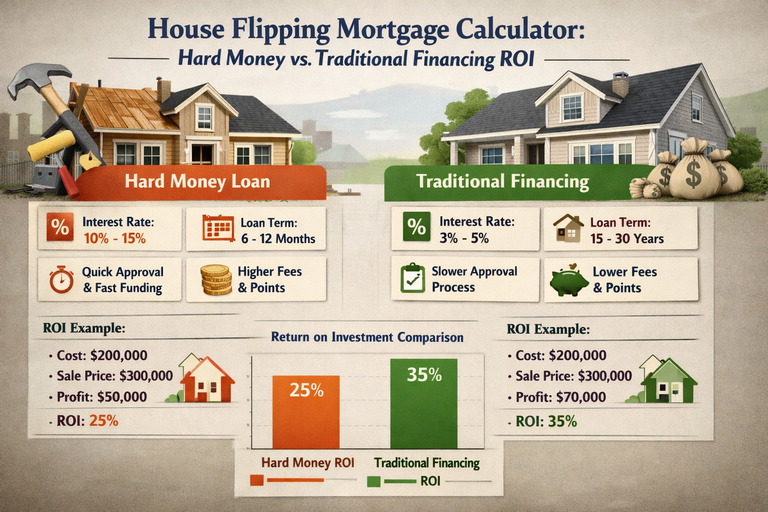
Hard money loans
Short-term, asset-based loans typically used for flips.
Typical 2025 terms:- Interest: 9%–13%
- Points: 2–4 points upfront
- Term: 6–12 months
- Down payment: 10%–25%
- Interest-only payments
Traditional financing
Conventional or renovation loans (harder to qualify).
Typical 2025 terms:- Interest: 6%–7%
- Points: 0–1
- Term: 15–30 years
- Slower approval
- Stricter condition requirements
Actionable truth: Hard money buys speed. Traditional loans buy margin.
2) The 70% ARV rule (the foundation of flip math)
The
After-Repair Value (ARV) is what the property should sell for
after renovations. The rule:
[\text{Max Purchase Price} = (ARV × 70%) − Renovation Costs] This rule exists to absorb:
- Financing costs
- Holding costs
- Sale costs
- Unexpected overruns
Example:
- ARV: $400,000
- Renovation: $60,000
[
(400,000 × 0.70) − 60,000 = $220,000
] If you pay more than $220,000, the deal is already fragile.
Actionable tip: If a deal doesn’t work at 70%, it won’t survive reality.
3) House flipping mortgage calculator (core inputs)
Any flip calculator must include:
Purchase side
- Purchase price
- Down payment
- Loan amount
- Interest rate
- Points
Renovation
- Rehab budget
- Draw fees (hard money)
- Overrun buffer (10–15%)
Holding costs (monthly)
- Interest payments
- Property taxes
- Insurance
- Utilities
- HOA
- Maintenance
Exit costs
- Agent commissions (5–6%)
- Closing costs (1–2%)
- Staging & concessions
Skipping
any of these inflates ROI artificially.
4) Hard money example (realistic numbers)
Deal assumptions:- Purchase price: $220,000
- Rehab: $60,000
- ARV: $400,000
- Hard money loan: 90% purchase, 100% rehab
- Rate: 11%
- Points: 3
- Hold time: 9 months
Financing costs
- Loan amount: ~$254,000
- Points (3%): ~$7,620
- Monthly interest: ~$2,325
- Interest over 9 months: ~$20,925
Holding + selling costs (est.)
- Taxes, insurance, utilities: ~$7,000
- Agent & closing costs: ~$24,000
Total costs
- Purchase + rehab: $280,000
- Financing & holding: ~$59,500
- Selling costs: ~$24,000
Total invested: ~$363,500
Sale price: $400,000 👉
Profit: ~$36,500
👉
ROI: ~10% (before taxes) That’s a
thin deal.
Actionable tip: Hard money compresses margins. Speed must compensate.
5) Traditional financing example (same deal)
Now assume:
- 20% down
- 6.5% interest
- No points
- Slower close, longer hold (12 months)
Financing costs
- Loan amount: ~$176,000
- Monthly P&I: ~$1,110
- Interest paid in year one: ~$11,200
Holding + selling costs
- Higher holding costs due to time: ~$10,000
- Agent & closing: ~$24,000
Total invested
- Higher cash down
- Lower interest
👉
Profit: ~$52,000
👉
ROI: Higher, but more capital tied up
Actionable tip: Traditional loans reward patience and liquidity.
6) ROI comparison: hard money vs traditional
| Factor | Hard Money | Traditional |
|---|
| Speed | Very fast | Slow |
| Cost | Very high | Lower |
| Cash required | Lower | Higher |
| Margin pressure | Extreme | Moderate |
| Best for | Short flips | Longer flips |
Key insight: Hard money doesn’t make bad deals good—it just makes them possible.
7) Holding costs: the silent profit killer
Every extra month kills ROI. Example:
- Hard money interest: ~$2,300/month
- Utilities, taxes, insurance: ~$800/month
👉
$3,100/month burn A 3-month delay =
$9,300 gone.
Actionable tip: Add 2–3 months buffer to every flip. If profit disappears, walk away.
8) When hard money makes sense
Hard money is rational when:
- The deal is deeply discounted
- Speed beats all alternatives
- You have contractor control
- The flip timeline is short
- ARV comps are strong and recent
If you’re using hard money because you
need it to qualify, the deal is already risky.
9) When traditional financing wins
Traditional financing is better when:
- Property qualifies for financing
- Timeline exceeds 9–12 months
- You have sufficient cash
- Profit margin is tight
- Market volatility is high
Lower carrying cost = higher survival rate.
Conclusion
House flipping profits are made
before you buy, not after you renovate. Hard money accelerates deals but compresses margins. Traditional financing improves ROI but requires patience and capital. The 70% ARV rule exists for a reason: it protects you from financing reality, not optimism. If your flip only works with perfect timing and no overruns, it doesn’t work.
FAQs
1) What is hard money financing? Short-term, high-interest loans based on property value, commonly used for flips.
2) What is the 70% ARV rule? A rule that limits purchase price to 70% of after-repair value minus rehab costs.
3) Is hard money bad? No—but it’s expensive. It only works when the deal margin is wide.
4) How long should a flip take? Ideally under 9 months. Longer timelines crush ROI.
5) What kills most house flips? Underestimating financing and holding costs—not renovation budgets.