In 2025, the biggest hidden cost in homeownership isn’t interest rates.
It’s
insurance driven by climate risk. Two homes with the same price and mortgage rate can differ by
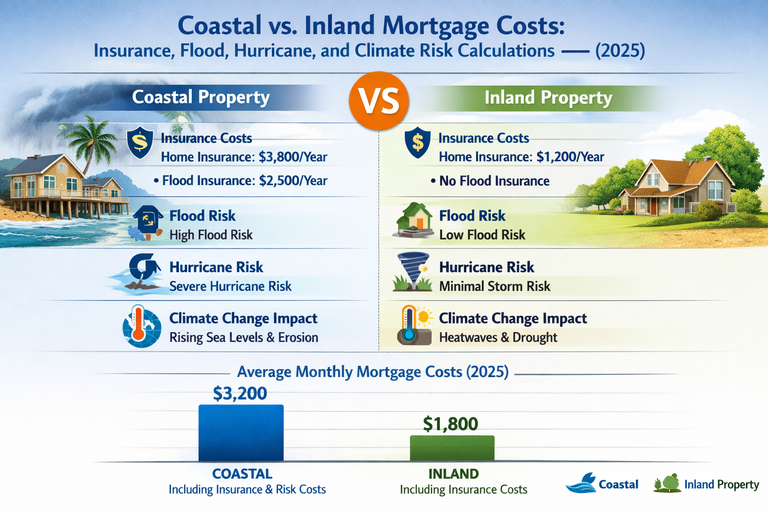
$800–$1,500 per month purely because of location. Coastal buyers are discovering this the hard way—often
after they’re under contract. This guide breaks down
how climate risk changes mortgage affordability, how lenders calculate coastal vs inland costs, and how to run the numbers
before you buy.
1) Why climate risk now directly affects mortgages
Historically, climate risk was abstract. Today it’s priced in. In high-risk zones, lenders must account for:
- Rising homeowners insurance premiums
- Mandatory flood insurance
- Hurricane or windstorm riders
- Fire risk surcharges
- Insurer withdrawal or non-renewal risk
These costs affect:
- Monthly payment (PITI)
- Debt-to-income (DTI)
- Loan approval and appraisal
- Long-term affordability
Actionable tip: If insurance isn’t quoted early, your affordability math is wrong.
2) Coastal vs inland: what actually changes
Let’s define terms clearly.
Coastal properties typically face:
- Flood zone exposure (FEMA)
- Hurricane and wind risk
- Saltwater corrosion risk
- Fewer insurance carriers
- Rapid premium increases
Inland properties typically face:
- Lower flood exposure
- Fire risk (in some regions)
- More stable insurance markets
- Lower volatility in premiums
The mortgage itself may be identical. The
non-mortgage costs are not.
3) Insurance cost comparison (realistic 2025 ranges)
Example: $500,000 home, same loan terms
Inland (low-risk area)
- Homeowners insurance: $1,400–$1,800/year
- Flood insurance: $0
- Monthly insurance: ~$125
Coastal (flood + hurricane zone)
- Homeowners insurance: $4,000–$7,000/year
- Flood insurance: $1,200–$3,000/year
- Windstorm rider: often included or extra
- Monthly insurance: ~$450–$850
That’s a
$325–$725/month difference—before taxes or HOA.
Actionable tip: Insurance, not mortgage rate, is now the main affordability lever in coastal markets.
4) Flood insurance: the deal-breaker buyers ignore
If a property is in a
Special Flood Hazard Area (SFHA):
- Flood insurance is mandatory for federally backed loans
- Coverage applies for the life of the loan
- Costs rise with FEMA map updates
Typical flood insurance costs (2025)
- Low-risk flood zone: $500–$800/year
- High-risk zone: $1,500–$3,500+/year
Flood insurance does
not:
- Build equity
- Reduce your rate
- Protect everything (coverage limits apply)
Actionable tip: Always check FEMA flood maps
before making an offer—not after.
5) DTI impact: how climate costs kill approvals
Lenders include insurance and flood premiums in
PITI.
Example
- Mortgage P&I: $2,900
- Property taxes: $550
Inland total PITI:- Insurance: $125
- Total: ~$3,575
Coastal total PITI:- Insurance + flood: $700
- Total: ~$4,150
That extra
$575/month can:
- Push DTI over limits
- Reduce buying power by $75k–$100k+
- Force a smaller loan or denial
Actionable tip: Climate risk reduces buying power just like higher interest rates.
6) Fire zones: the inland climate trap
Inland doesn’t always mean safe. High fire-risk areas face:
- Insurance non-renewals
- Forced use of state-backed insurers
- High deductibles
- Limited coverage options
California, Colorado, and parts of the West are prime examples.
Fire risk insurance reality
- Premiums rising 20–40% annually in some zones
- Fewer carriers willing to underwrite
- Lenders may reject policies with exclusions
Actionable tip: Ask insurers
if they’ll renew, not just if they’ll issue a policy today.
7) Long-term risk: insurance volatility matters more than today’s cost
Mortgage rates are fixed.
Insurance is not. Coastal buyers face:
- Unpredictable premium hikes
- Mid-loan affordability erosion
- Forced escrow increases
- Refinance difficulty if costs explode
A home affordable today can become unaffordable
without any change to income or rate.
Actionable tip: Stress-test insurance rising 30–50% over 5 years. If that breaks the budget, walk away.
8) Coastal vs inland: full monthly cost comparison
Same home price: $500,000
Same loan, same rate
| Cost Component | Inland | Coastal |
|---|
| Mortgage P&I | $2,900 | $2,900 |
| Taxes | $550 | $550 |
| Insurance & flood | $125 | $700 |
| Total Monthly | $3,575 | $4,150 |
Difference: ~$575/month
That’s
$207,000 over 30 years—purely from climate risk.
9) When coastal buying can still make sense
Coastal properties can work if:
- You have high discretionary income
- You maintain large cash reserves
- Insurance costs are a small % of income
- You plan for self-insurance later
- You accept long-term volatility
It’s not about fear—it’s about
capacity.
Actionable tip: Climate risk is manageable only if it’s optional, not existential.
Conclusion
In 2025, climate risk is no longer hypothetical—it’s embedded in your monthly payment. Coastal homes carry rising, unpredictable insurance costs that directly affect mortgage approval, affordability, and long-term stability. Two buyers with the same income and loan can have wildly different outcomes based solely on
geography. Before choosing coastal or inland, calculate:
- Insurance today
- Insurance volatility tomorrow
- DTI impact
- Long-term affordability under stress
If the math works only under perfect conditions, it doesn’t work.
FAQs
1) Do lenders require flood insurance? Yes, if the property is in a FEMA-designated flood zone and the loan is federally backed.
2) Are coastal homes harder to finance? They can be, due to insurance availability, higher PITI, and appraisal risk.
3) Can insurance costs change after closing? Yes—insurance premiums can rise annually and affect escrow payments.
4) Are inland homes always safer? No. Fire zones and extreme weather can create similar insurance challenges inland.
5) What’s the biggest mistake buyers make? Ignoring insurance costs until after they’re under contract.