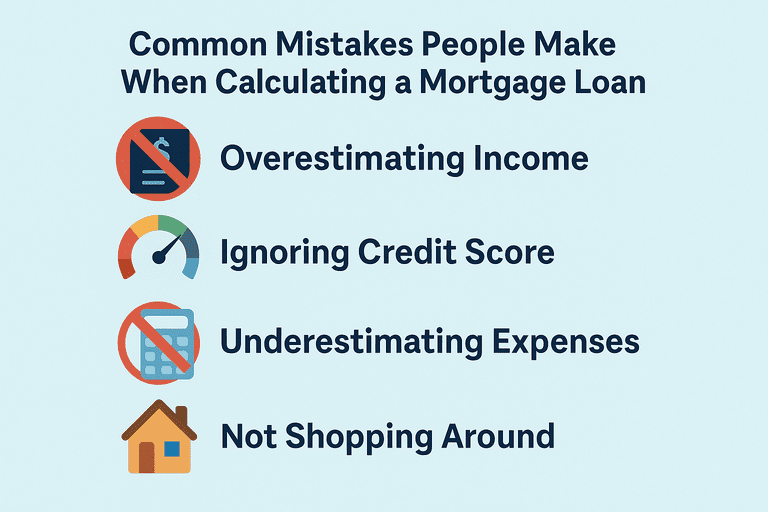
Calculating a mortgage loan might seem straightforward, but small errors in the process can lead to big financial surprises later. Many homeowners underestimate their payments, forget to include key costs, or misjudge affordability. For a full breakdown of how to calculate correctly, see our Complete Step-by-Step Mortgage Guide
This guide highlights the most common mistakes people make when calculating a mortgage loan—and how you can avoid them.
1. Ignoring Taxes and Insurance
Many people calculate only principal + interest, forgetting that lenders often require property taxes and homeowners insurance to be included in the monthly payment (escrow).
Tip: Always calculate PITI (Principal, Interest, Taxes, Insurance) for a realistic monthly budget.
2. Forgetting About PMI
If your down payment is less than 20%, you’ll likely have to pay Private Mortgage Insurance (PMI). This extra monthly cost protects the lender, not you, and can add $50–$200 per month depending on loan size.
Tip: Factor in PMI when estimating your payment, and plan to remove it once you reach 20% equity.
3. Using the Wrong Interest Rate
Borrowers sometimes confuse APR (Annual Percentage Rate) with the base interest rate. APR includes fees, so your actual cost of borrowing may be higher than expected.
Tip: When running calculations, use the actual interest rate for the formula, but also compare APRs across lenders for the full cost picture.
4. Not Considering Loan Term Differences
A 15-year loan has higher monthly payments but much lower total interest, while a 30-year loan offers affordability but doubles (or more) the lifetime interest.
Mistake: Only looking at the monthly payment, not the long-term interest cost.
5. Forgetting Closing Costs
Upfront fees like appraisals, title, and origination fees can add 2–5% of the loan amount. Ignoring these costs makes the mortgage look cheaper than it really is.
Tip: Always add closing costs into your “true cost” calculation.
6. Overestimating Affordability
Just because you can qualify for a higher loan doesn’t mean you should take it. Stretching your budget leaves little room for emergencies or lifestyle changes.
Tip: Aim for a mortgage payment that’s no more than 25–30% of your take-home income.
7. Ignoring Extra Payment Strategies
Some people assume their loan term is fixed—but even small extra payments toward principal can save years and thousands in interest.
Tip: Always run scenarios with extra payments to see how much faster you could pay off your mortgage.
8. Not Double-Checking Calculator Results
Online mortgage calculators are useful, but they don’t always include taxes, insurance, PMI, or HOA fees.
Tip: Use manual calculations alongside calculators to verify accuracy.
Conclusion
Most mistakes in mortgage loan calculations come from overlooking costs, misjudging affordability, or relying too heavily on simplified tools. By factoring in PITI, PMI, closing costs, and loan term trade-offs, you’ll avoid surprises and make more confident financial decisions.