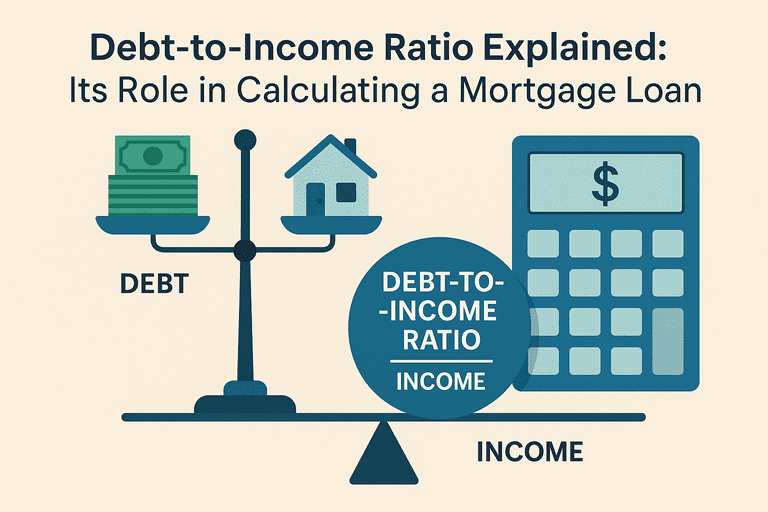
Understanding your Debt-to-Income Ratio (DTI) is just as crucial as knowing the mortgage formula. Mortgage lenders rely heavily on your DTI to judge whether you can manage a new loan comfortably. If you’re looking for step-by-step guidance on mortgage math, our How to Calculating a Mortgage Loan
1. What Is DTI and Why It Matters
DTI is a measure of what portion of your pre-tax income is already committed to repaying debts—an important indicator of financial health. Lenders use it to determine how much of an additional mortgage payment you can handle. A high DTI is frequently cited as a top reason mortgage applications are denied.
2. Front-End vs Back-End DTI Explained
Front-End DTI includes only housing-related costs—mortgage principal & interest, property taxes, insurance, and PMI (together known as PITI) divided by gross income.
- Back-End DTI is broader: it adds all other recurring debt obligations (like credit cards, auto loans, student loans, alimony) to your housing costs and divides the total by your gross monthly income.
3. How to Calculate DTI (with Example)
Back-End DTI Formula:
Back-End DTI = (Total Monthly Debt Payments + Proposed Mortgage Payment) ÷ Gross Monthly IncomeExample:
If your gross monthly income is $7,000, and your total recurring debts are $800 (student loans), plus a projected mortgage payment (PITI) of $1,800:
Back-End DTI = ($2,600 ÷ $7,000) ≈ 37%
4. What’s a Healthy DTI?
Front-End DTI Ideal: ≤28%
Back-End DTI Ideal: ≤36%, though many lenders allow up to ~43% for conventional loans and up to 50–55% for certain FHA, USDA, or VA loans—especially if the borrower demonstrates strong financial compensating factors.
5. How DTI Influences Mortgage Calculations
Approval: Exceeding DTI thresholds can disqualify your application or limit your borrowing capacity.
Loan Size: A lower DTI may qualify you for a larger loan or better terms.
Interest Rates: Lower DTI profiles often receive better interest rates.
6. Improving Your DTI Before Applying
Pay down existing debts (especially high-interest credit cards).
Increase your gross income—ask for a raise, take on side work, or bring in a co-borrower.
Refinance or consolidate loans to lower monthly payments.
Delay new credit applications that could raise monthly obligations.
7. DTI and Mortgage Calculation: The Connection
While your DTI doesn’t affect the basic mortgage formula itself (which calculates your monthly payment), it determines whether that payment is realistic and acceptable to lenders. A precise mortgage payment calculation, combined with DTI analysis, helps ensure you choose a responsibly sized loan.
Conclusion
DTI is a gatekeeper in the mortgage approval process—it reflects your ability to manage new payments alongside existing obligations. Whether you’re using detailed formulas or handy calculators, always compare your projected mortgage payments with your DTI. A strong DTI not only eases approval but also qualifies you for better loan terms.