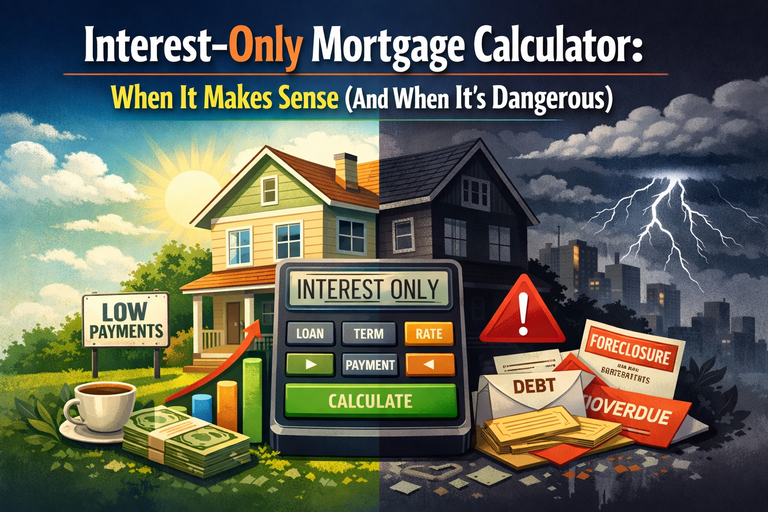
Interest-only mortgages are back in the conversation in 2025—not because they’re safer, but because
high home prices and 6–7% rates are pushing buyers to look for relief. For high earnners and investors, interest-only (IO) loans can look sophisticated and strategic. For everyone else, they often hide a
delayed financial cliff. This article shows you:
- How interest-only mortgages actually work
- How to calculate payment shock when principal starts
- What happens to equity (or doesn’t)
- When IO loans make sense—and when they’re reckless
No hype. Just math.
1) What an interest-only mortgage really is
An
interest-only mortgage allows you to:
- Pay only interest for a set period (usually 5–10 years)
- Make no principal reduction during that time
- Then switch to full principal + interest payments
You are not “saving money.”
You are
deferring principal. After the interest-only period ends, the remaining balance must be paid off over a
shorter amortization period, causing a sharp payment increase.
Actionable tip: If you don’t know exactly what your payment becomes later, you should not use this loan.
2) Why interest-only loans look attractive in 2025
IO loans appeal to buyers because they:
- Lower initial monthly payments
- Increase short-term cash flow
- Allow purchase of more expensive properties
- Appeal to bonus-heavy or variable-income earners
Example:
- 30-year fixed at 6.75% on $700k loan → ~$4,540/month
- Interest-only at 6.75% → ~$3,940/month
That ~$600 difference is seductive.
Actionable tip: Any loan that “solves” affordability by postponing repayment deserves extra scrutiny.
3) Interest-only mortgage calculator (core math)
Step 1: Interest-only payment
[\text{Monthly IO Payment} = \frac{Loan Amount \times Interest Rate}{12}]
Example:
- Loan: $700,000
- Rate: 6.75%
[700,000 \times 0.0675 ÷ 12 ≈ $3,937] No equity is built. Balance remains $700,000.
4) Payment shock: where IO loans get dangerous
Now the part most buyers underestimate. Assume:
- 10-year interest-only period
- Remaining term: 20 years
- Loan balance still: $700,000
New payment after IO period:
- 20-year amortization at same rate (~6.75%)
- New payment ≈ $5,300/month
Payment shock:
- Before: ~$3,940
- After: ~$5,300
- Increase: ~$1,360/month
That’s a
34% jump overnight. And this assumes rates
don’t go up.
Actionable tip: If you can’t afford the post-IO payment
today, you can’t afford the loan.
5) Equity reality: IO vs traditional mortgage
Let’s compare after 10 years.
Interest-only loan
- Balance after 10 years: $700,000
- Equity gained: $0 (excluding appreciation)
Traditional 30-year loan
- Same loan, same rate
- Balance after 10 years: ~$593,000
- Equity gained: ~$107,000
IO borrowers rely entirely on
appreciation to build equity. If prices stall or fall, they are exposed.
Actionable tip: Interest-only loans amplify downside risk more than upside reward.
6) When interest-only mortgages can make sense
IO loans are not automatically bad—but they are
specialty tools. They may make sense if:
- You have very high, stable income
- You receive predictable large bonuses
- You plan to sell within the IO period
- You are an experienced investor with reserves
- The property generates strong cash flow
In these cases, IO is a
liquidity strategy, not an affordability crutch.
Actionable tip: IO loans should increase flexibility—not stretch affordability.
7) When interest-only mortgages are a red flag
IO loans are dangerous if:
- You need them to “qualify”
- You’re betting on refinancing later
- You have limited cash reserves
- Your income is uncertain
- You’re buying a primary residence near your max budget
These loans magnify:
- Market risk
- Income risk
- Refinancing risk
Actionable tip: If your plan requires appreciation or rate drops, the loan is misused.
8) Stress-testing an IO mortgage (do this first)
Before using an IO loan, test: 1️⃣ Can I afford the
post-IO payment today?
2️⃣ What happens if rates are 1% higher later?
3️⃣ What if the home doesn’t appreciate?
4️⃣ Do I have 12–18 months of reserves
after purchase? If any answer is “no,” the loan is unsafe.
Conclusion
Interest-only mortgages are not clever shortcuts—they’re
deferred obligations. Used intentionally by the right borrower, they can improve cash flow and flexibility. Used to stretch affordability, they quietly set up future payment shock and equity risk. The danger isn’t the interest-only period.
It’s pretending the bill never comes due. If you wouldn’t take the fully amortized loan today, don’t disguise it with interest-only terms.
FAQs
1) What is an interest-only mortgage? A loan where you pay only interest for a set period, with no principal reduction.
2) Why are interest-only loans risky? They delay equity buildup and cause large payment increases when amortization begins.
3) Do interest-only loans ever make sense? Yes—for high-income, well-capitalized borrowers with clear exit strategies.
4) How big is payment shock after interest-only ends? Often 30–50% higher, depending on loan size, rate, and remaining term.
5) Are interest-only mortgages common in 2025? They exist but are niche products, mostly used by investors and high earners.