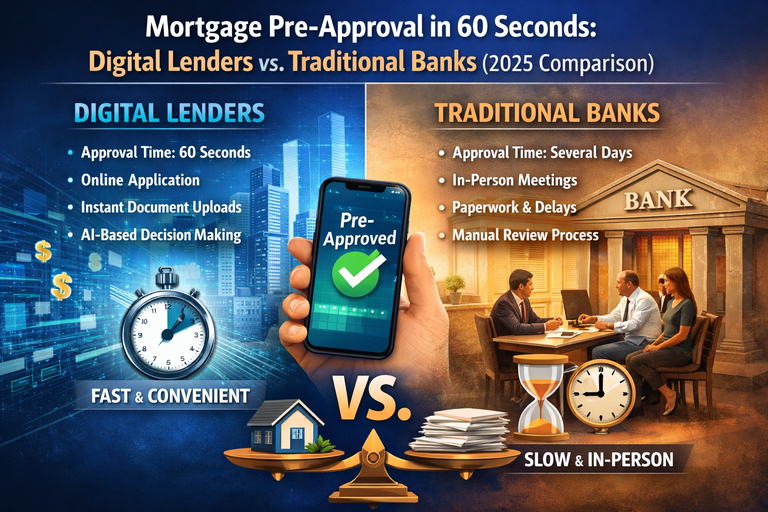
“Get pre-approved in 60 seconds.” In 2025, that promise is everywhere—and it’s tempting in competitive housing markets where speed feels like everything. But here’s the uncomfortable reality:
speed and accuracy are not the same thing. Many buyers confuse instant pre-approvals with real underwriting, and that mistake can cost deals, deposits, and credibility with sellers. This guide breaks down how
digital pre-approvals actually work, how they compare to
traditional bank pre-approvals, and which one you should rely on when it really matters.
1) What a mortgage pre-approval actually is (not marketing)
A real pre-approval means a lender has:
- Reviewed your income
- Verified assets
- Checked credit
- Calculated DTI
- Applied loan program rules
What it is
not:
- A rate lock
- A loan commitment
- A guarantee you’ll close
Actionable tip: If the lender hasn’t reviewed documents, you’re likely pre-qualified—not pre-approved.
2) How 60-second digital pre-approvals work
Fast digital lenders rely on:
- Self-reported income
- Automated data pulls (credit, bank balances)
- Algorithmic assumptions
- Minimal human review
The system answers one question:
“Does this borrower probably qualify?”
That’s useful—but incomplete.
What they usually skip:- Full income documentation review
- Bonus/commission income rules
- Student loan recalculations
- Self-employment nuances
- Property-specific issues
Actionable tip: Treat instant pre-approvals as
screening tools, not final authority.
3) Traditional bank pre-approvals: slower, but deeper
Traditional lenders (banks, credit unions, brokers) usually:
- Collect pay stubs, W-2s, tax returns
- Review asset statements manually
- Apply conservative DTI limits
- Flag issues early
This takes longer—often days, not minutes—but produces a
stronger approval.
Actionable tip: Sellers and listing agents trust fully-documented pre-approvals more than instant ones, especially in competitive markets.
4) Side-by-side comparison (what really matters)
| Feature | Digital 60-Sec | Traditional Bank |
|---|
| Speed | Very fast | Slower |
| Documentation | Minimal | Full |
| Accuracy | Medium | High |
| Seller confidence | Lower | Higher |
| Complex income | Weak | Strong |
| Risk of denial later | Higher | Lower |
Key insight: Speed helps you
shop. Accuracy helps you
close.
5) Real example: how buyers get burned
Scenario- Buyer income: $120,000 (includes bonuses)
- Student loans: $600/month
- Digital pre-approval: $550,000
- Traditional underwriting result: $470,000
Why the gap?
- Bonus income averaged down
- Student loans recalculated
- Insurance and taxes underestimated
Buyer makes offer based on $550k approval → deal falls apart during underwriting.
Actionable tip: Always run your numbers through a
DTI and affordability calculator before trusting an instant letter.
6) When instant pre-approval actually makes sense
Digital pre-approvals are useful when:
- You’re early in the search
- You want a quick affordability range
- Your income is simple (W-2, salaried)
- You plan to follow up with full underwriting
They are risky when:
- You’re self-employed
- You rely on commissions or gig income
- You’re near DTI limits
- You’re buying multi-unit or high-tax properties
Actionable tip: Use digital speed early, traditional depth before offering.
7) The hybrid strategy smart buyers use
The most successful buyers in 2025 do this:
- Instant digital pre-approval → quick range
- Full traditional pre-approval → offer confidence
- Updated approval before offer → zero surprises
This gives you speed
and credibility.
Actionable tip: Ask lenders if they’ll convert a digital pre-approval into a fully underwritten one before you write offers.
8) What sellers and agents actually care about
In competitive markets, sellers want:
- Certainty of closing
- Clean financing
- No re-negotiations
A fully reviewed pre-approval letter:
- Signals seriousness
- Reduces deal risk
- Can beat a higher offer with weaker financing
Actionable tip: In bidding wars, financing strength often matters more than price.
Conclusion
In 2025, mortgage pre-approval speed is easy.
Approval accuracy is rare. Instant 60-second pre-approvals are great tools—but dangerous if mistaken for real underwriting. Traditional pre-approvals take longer, but they protect you from failed deals, lost deposits, and painful surprises. Use speed to explore.
Use depth to commit.
And never confuse marketing promises with lender reality.
FAQs
1) Is a 60-second mortgage pre-approval real? It’s real—but usually based on limited data and assumptions, not full underwriting.
2) Can an instant pre-approval be denied later? Yes. Many are adjusted or denied once documents are reviewed.
3) Do sellers accept digital pre-approvals? Some do, but many prefer fully documented approvals—especially in competitive markets.
4) Which is better: digital or bank pre-approval? Neither alone. The best approach is using both at the right stage.
5) When should I get a full pre-approval? Before making offers—always.