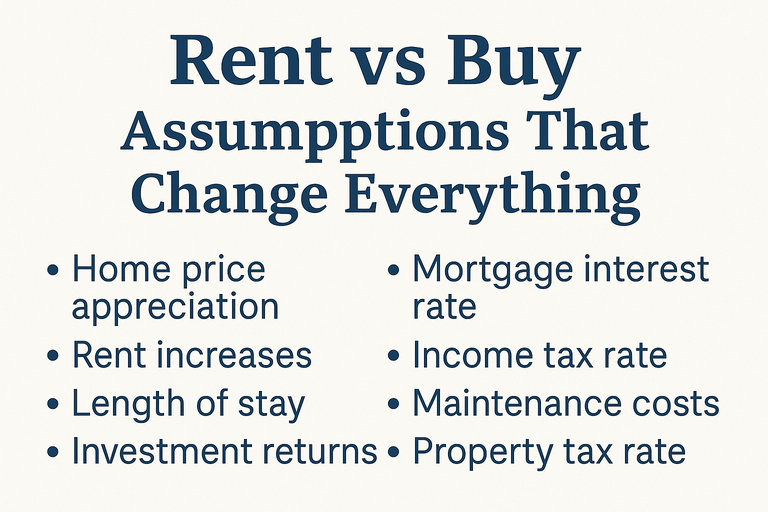
Ever run a rent vs buy calculator and get a different result than your friend?
That’s not a glitch — it’s because tiny assumption changes completely shift the outcome.
Factors like home appreciation, rent inflation, and ownership horizon can flip a “buy” recommendation into “rent” in seconds.
This guide breaks down the four assumptions that matter most — and how to model them correctly with our Rent vs Buy Calculator
1. Appreciation: How Fast Your Home’s Value Grows
Home appreciation drives the long-term benefit of ownership.
A 1–2% difference in annual growth can mean hundreds of thousands in equity over time.
| Annual Appreciation | 10-Year Equity Gain (on $400K home) |
|---|---|
| 2% | $87,000 |
| 3% | $137,000 |
| 4% | $196,000 |
Tip:
If you live in a high-growth metro like Miami, Austin, or Tampa, test 4–5% annual appreciation.
If you’re in slower markets or factoring inflation, use 2–3%.
Use the “Home Value Growth Rate” field in the Rent vs Buy Calculator
2. Rent Inflation: The Hidden Cost of Staying Put
Rent rarely stays flat — in many cities, it increases 3–6% per year.
That means even if buying feels more expensive today, ownership can become cheaper within a few years.
| Rent Inflation | 5-Year Rent Change (Starting at $2,500/month) |
|---|---|
| 0% | $2,500 |
| 3% | $2,897 |
| 5% | $3,191 |
What to model:
Use your city’s historic rent inflation (Zillow or Census data).
Consider whether local rent control caps annual increases.
Check if your mortgage payment stays fixed — that stability is your inflation shield.
💡 Run scenarios in the calculator with 0%, 3%, and 5% rent growth — you’ll see how fast the buy advantage appears.
3. Selling Costs: The Forgotten Factor
Even if your home appreciates, selling costs (typically 6–8% of sale price) can erase years of gains if you sell too soon.
Example:
Home purchased for $400,000
Sells after 4 years for $440,000 (2.4% annual growth)
Appreciation gain: $40,000
Selling costs: 6% × $440,000 = $26,400
→ Net equity gain: only $13,600
If you sell early, transaction costs dominate.
That’s why most calculators assume at least a 5-year horizon before buying pays off.
Include 6–8% “selling costs” in the assumptions section of the Rent vs Buy Calculator for accuracy.
4. Horizon Length: How Long You’ll Stay
The holding period is the most powerful input.
Buying only makes sense if you’ll stay long enough for equity growth and cost recovery.
| Time in Home | Likely Better Option |
|---|---|
| 1–3 years | Rent (selling costs too high) |
| 4–7 years | Depends on rate & appreciation |
| 8+ years | Buy (ownership benefits compound) |
5. Other Variables That Matter (But Less Than You Think)
| Factor | Impact | Notes |
|---|---|---|
| Mortgage Rate | High | Every 1% = ~$300–$400/month difference |
| Property Taxes | Moderate | Often offset by appreciation |
| Maintenance | Moderate | Budget 1–2% of home value annually |
| Down Payment | Moderate | Affects upfront cost, not long-term ROI |
6. The Real Power of Calculator Sensitivity
The Rent vs Buy Calculator isn’t about a yes/no answer — it’s about understanding which assumption matters most for you.
Here’s how to use it strategically:
Set baseline values (local taxes, rate, down payment).
Change one variable (e.g., appreciation from 2% → 4%).
Watch the “break-even year” shift.
Decide whether your assumptions are realistic for your market.
🧮 Pair it with the How Much House Can I Afford Calculator to test affordability under both scenarios.
7. Case Study: 5-Year Horizon
Scenario:
$2,500 rent, 4% annual increase
$400,000 home, 6.5% mortgage, 3% appreciation
5-year ownership horizon
Results:
Renting cost after 5 years: $161,000
Owning cost (net of appreciation): $155,000
→ Break-even: Year 5
Push the horizon to 8 years, and buying wins by over $50,000.
8. Key Takeaways
Home appreciation and rent inflation are the biggest swing factors.
Selling costs make short stays unprofitable for buyers.
The “stay-or-go” horizon determines your break-even year.
Test 3–5 scenarios to understand your range of outcomes — not just one.
FAQ
How many years should I stay in a home to make buying worth it?
Usually 5–7 years, depending on rates, appreciation, and selling costs.How much should I assume for home appreciation?
2–4% per year is a conservative national average; check local trends.What’s a safe rent inflation assumption?
3–5% annually unless your area has rent control or stagnant population growth.Does renting always lose long-term?
Not always—if housing prices stagnate or you move frequently, renting can be smarter short-term.